
Three-Light Interior
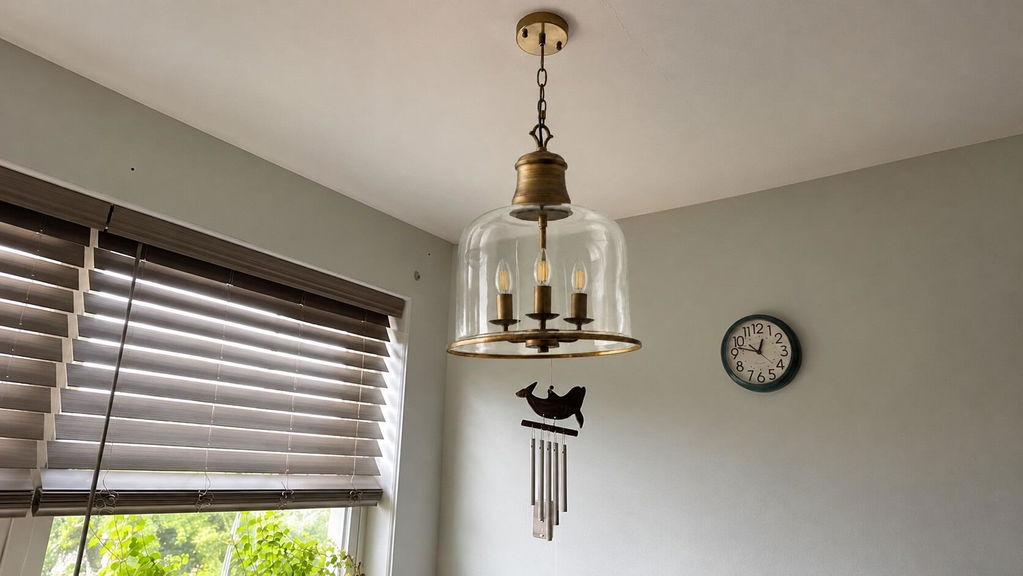
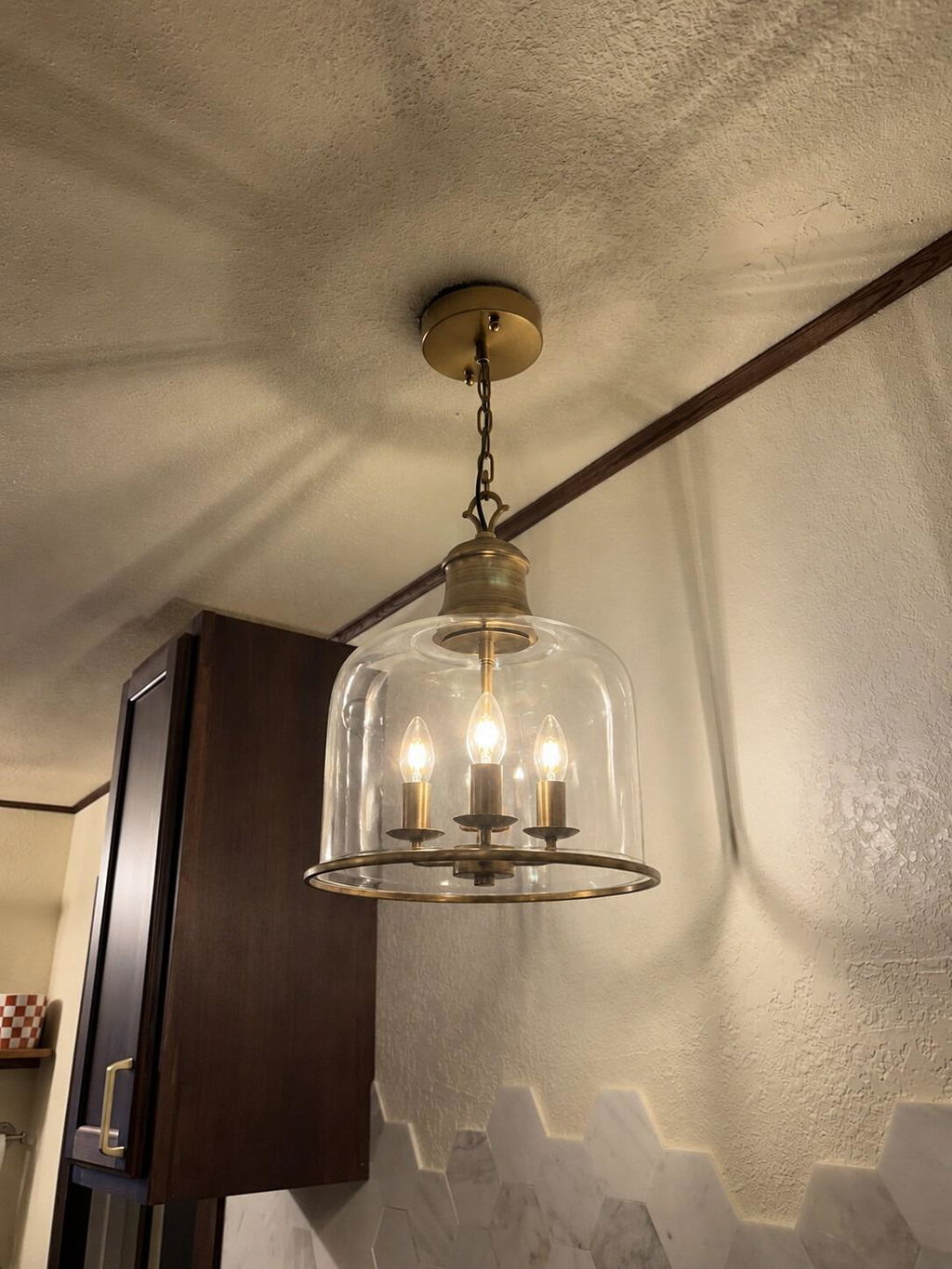
Candle-style holders create a balanced, luminous center.


Buy 1
Buy 2
Buy 3+
Orders over $330
Orders over $500
Return Policy: You have 14 days after receiving your order to request a return.
Availability: We ship to the United States.
Processing Time: Order handling time is 1 – 2 business days (Monday to Friday).
 Free Shipping
 14-Day Returns
 Secure Payment
 Customer Service
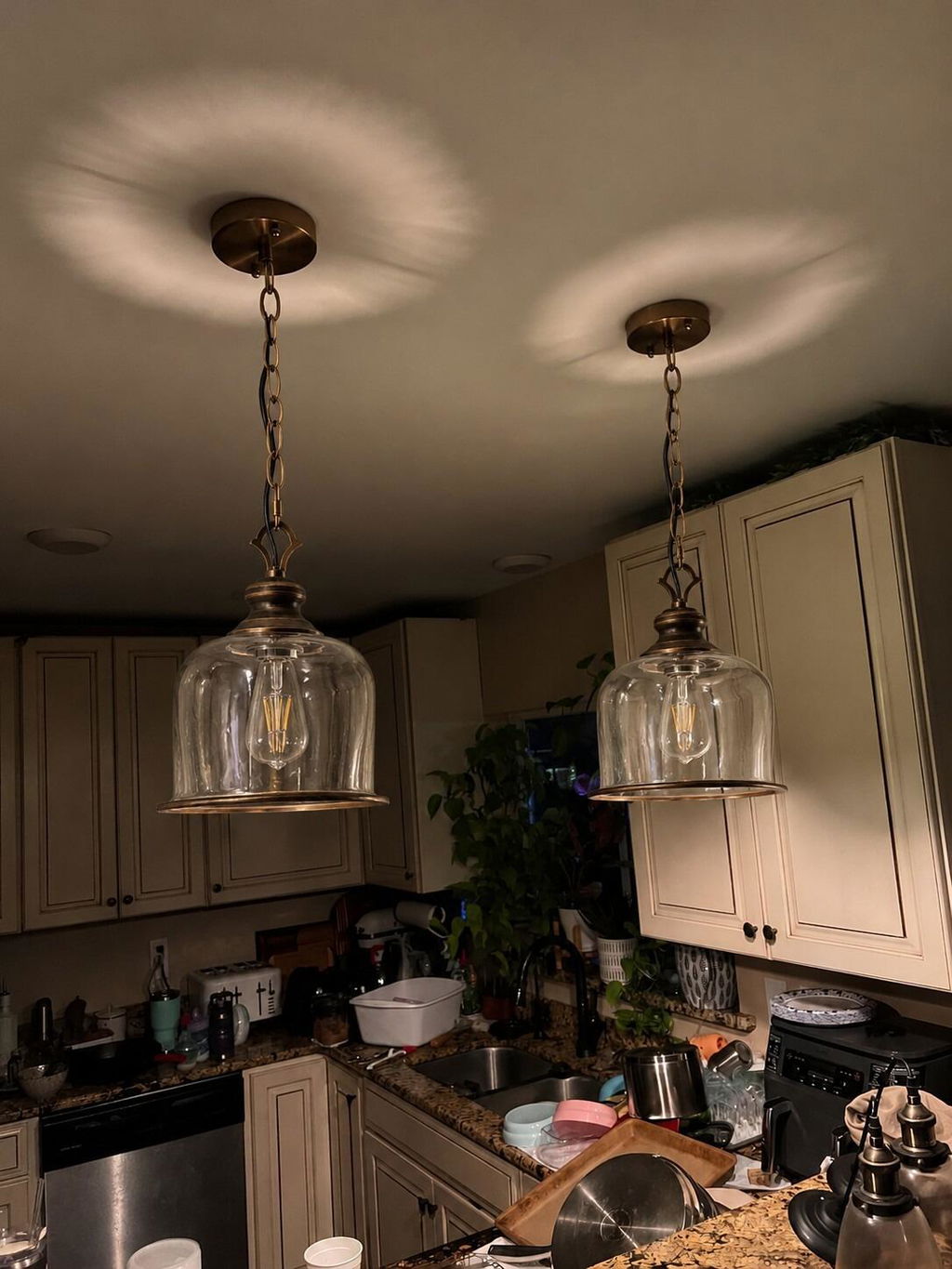
A rounded bell-shaped glass shade reveals the candle-style lamp holders within. Clear Glass keeps the silhouette open and airy, while Amber Glass lends the same vintage form a warmer glow.
Every detail stays in view: the layered metal crown, exposed candle sockets, and smooth glass bell make the fixture feel like a collected vintage piece.
Candle-style holders create a balanced, luminous center.

Warm amber glass deepens the atmosphere without hiding the light.

The shaped top and chain link add a traditional lantern note.

Inspired by old-world glass lanterns, this pendant uses a generous bell shade and a simple chain suspension to make a functional light feel quietly decorative.
Its transparent profile works over a dining table or kitchen island, while the Amber Glass version brings a softer presence to bedrooms and transitional spaces.
Clear Glass keeps kitchen islands, dining tables, and breakfast nooks bright and open. Amber Glass brings the same bell into the bedroom with a warmer glow.


| Materials | Glass shade with metal frame and chain suspension |
|---|---|
| Glass Options | Clear Glass or Amber Glass |
| Metal Options | Black or antique brass finish |
| Small | Dia 9.4 in x H 13.8 in / Dia 24 cm x H 35 cm |
| Large | Dia 13.8 in x H 19.7 in / Dia 35 cm x H 50 cm |
| Bulb Base | E27 for Small; E14 for Large |
| Included | Bulbs not included |
| Suggested Spaces | Kitchen island, dining room, entryway, bedroom, or living room |


Choose Large for a kitchen island, dining table, or a room with enough width and height for a fuller shade. Uses an E14 bulb.
Choose Small for a breakfast nook, bedside corner, entryway, or compact table. Uses an E27 bulb.
This pendant light is absolutely stunning in person. The clear glass shade has a beautiful sculptural look that catches the light perfectly, and the gold accents add just the right touch of warmth and sophistication.
Super cute and easy to install. Matches the vintage aesthetic of my house!
Love love love!! Adorable pendant and amazing quality!! Easy to install and shipped with care also!
Stunning! Absolutely love these pendant lights, easy to adjust and look so beautiful in our room.
These pendants are beautiful!! I was looking for a stylish, vintage look and these nailed it!
Monulo · The practical guide
Find a starting size, see where to place it, and know what to check before installation.
Find your starting size01 · Get the scale right
For a central ceiling light, enter your room dimensions. For lights above furniture, use the table or island guide below instead.
Measure first, then mock up the actual shape. Suggested dimensions are design starting points; product instructions and applicable local requirements take priority.
02 · Look up
The available drop matters as much as the fixture diameter.
Around 8 ft / 2.44 m
Start with a flush or compact semi-flush design in walking areas. Check the complete installed height.
Around 9–10 ft / 2.74–3.05 m
Pendants become easier to accommodate. Reserve enough clearance below the lowest part of the fitting.
Above 10 ft / 3.05 m
Test larger forms or longer suspension. Confirm cable length, access for maintenance and ceiling support.
Sloped ceiling? Compatibility is model-specific. Confirm the canopy, suspension angle and required drop before ordering.
Room study 01
Let the furniture define the focal point.
Room study 02
Plan the whole row before choosing the quantity.
Room study 03
Use the room formula as a visual starting point.
Room study 04
A consistent rhythm works better than a crowded ceiling.
Room study 05
Put comfortable facial lighting first.
Room study 06
Choose the height from where you actually sit.
Room study 07
Light the page without exposing the source.
03 · Before the tools come out
Bring the product instructions, room measurements and fixture weight to your installer.
01 / Fit
Check door swings, seated views, shade gaps and the lowest point. Include the canopy and suspension in every drop measurement.
02 / Support
Have a qualified installer confirm the box, fixing points and structural support for the complete fixture weight.
03 / Compatibility
Confirm supply voltage, lamp or LED driver, dimmer compatibility, ceiling type and location rating for the exact model.
Hardwired fixtures should be installed by a qualified electrician following the supplied instructions and local requirements. This page explains planning and placement; it does not provide wiring instructions.
04 · The last few details
Measure vertically from the finished ceiling to the lowest point of the assembled fitting. Over a table or counter, measure the remaining gap from that point to the surface.
No. Diameter describes the physical size. Compare lumen output, shade opacity, beam direction and the room’s other light sources separately.
Start with the shade diameter, then draw the complete row to scale. Two larger shades and three small shades can both work; use actual edge gaps and counter-end clearances to decide.
Compare a shorter suspension or a flush alternative that the manufacturer supports. Never shorten a rigid stem or modify wiring without the appropriate product guidance.
No. Check the exact product specification and installation position. Ask a qualified installer to confirm the required damp or wet rating and canopy compatibility.
Include a room photo, ceiling height, room or furniture dimensions, the fixture link and your proposed installation location. For heavier fittings, include any available mounting information.